The Styling Note
Why this look
earns its place.
Fit, balance, colour, and context—explained for real-world wear.
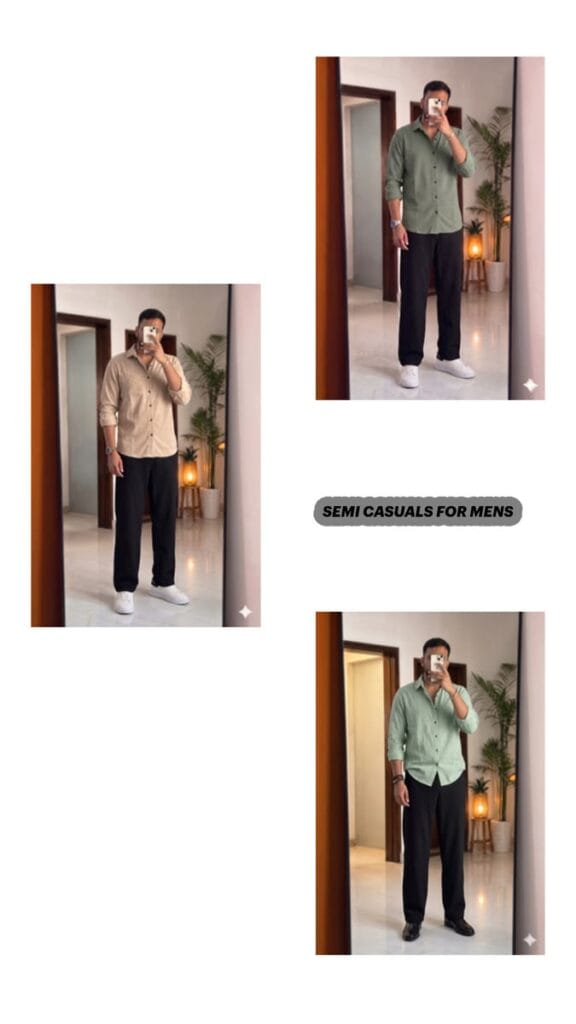
A beige shirt for men india is quietly becoming the smartest neutral in the wardrobe, and the butter-beige one in this photo shows why. Pale, warm, almost cream, worn here with light grey jeans and a silver watch. It does everything a white shirt does, minus the glare.
Butter beige is the neutral for men who find white shirts too stark and cream too safe. It has a warmth that flatters Indian skin tones in a way pure white never quite manages, and it photographs soft instead of blown-out. In a sea of white shirts at any gathering, the man in butter beige looks like he knows something.
Why this beige shirt for men works
The color sits in a precise spot: light enough to function as a neutral, warm enough to have personality. It pairs with almost everything a white shirt pairs with (dark jeans, chinos, white trousers), but it never creates the harsh contrast that makes white shirts look formal by default. Beige keeps the outfit in casual territory without any extra effort.
The chest pocket keeps it honest. A pocket on a solid light shirt adds a workwear note that stops the beige from reading precious or pyjama-like. It is a small detail doing real work: breaking the flat expanse of pale fabric so the eye has somewhere to rest.
The grey jean pairing
Light grey jeans are the inspired choice here, and they deserve credit. Blue jeans with a beige shirt would be fine but predictable; black jeans would be too severe against the pale top. Grey sits in the middle, casual like denim and calm like the shirt, and the washed-out tone keeps the whole outfit in the same soft register.
The straight, relaxed cut of the jeans matters. A beige shirt over skinny jeans would look unbalanced, the pale top floating over a dark narrow base. The easy straight leg here mirrors the shirt’s relaxed fit, and the two pieces look like they were chosen together rather than grabbed separately.
Fit: the pale-shirt rules
Pale shirts show everything, so fit has to be cleaner than with dark colors. No pulling at the buttons, no excess fabric blousing at the waist. The butter beige will broadcast every fit flaw in daylight. The shirt in the photo skims the torso with room to move, which is the target.
Sleeves rolled to the forearm, as shown, are the right call for daytime. A pale shirt with buttoned cuffs and no jacket can look oddly formal, like you forgot the blazer; the rolled sleeve signals casual intent. For evening, add the jacket or button the cuffs. The shirt handles both.
The silver watch and nothing else
A silver watch is the complete accessory plan. Against butter beige, silver reads cooler and cleaner than gold, which would push the outfit toward a warmer, dressier register. The watch in the photo is the only hard edge in a soft outfit, and that contrast is doing quiet work.
Resist the urge to add more. A beige shirt is already a subtle flex. It says you are confident enough to wear a color that shows every stain. Piling on bracelets or chains would turn quiet confidence into noise. Let the color be the statement.
Where butter beige earns its keep
Brunch, daytime dates, college, casual Fridays, evening plans that start outdoors. Butter beige is a daylight color that transitions to evening without complaint. It is also one of the few light shirts that works for Indian festive occasions without looking like you tried to wear white and missed.
The one caution is mess. A butter-beige shirt at a street-food crawl is a brave choice, and bravery is not always rewarded. Wear it where the food comes on plates, not in newspaper cones.
Keeping beige beige
Wash it alone or with other lights, always. Beige picks up dye from dark clothes faster than white does, and a greyed-out beige shirt looks dirty rather than vintage. Cold water, mild detergent, dry in shade. Sun yellows pale warm tones the way it does ivory.
Iron or steam before every wear. Wrinkles on a pale shirt read ten times louder than wrinkles on a dark one, and butter beige wrinkled looks neglected rather than relaxed. Four minutes with the iron is the price of wearing the color, and it is worth paying.
 MEN’S STYLE