The Styling Note
Why this look
earns its place.
Fit, balance, colour, and context—explained for real-world wear.
Most striped shirts in a man’s wardrobe are blue. A white and black striped shirt men style for college and casual Fridays is the monochrome answer to the striped shirt problem. High contrast, no color to manage, and the stripes do the elongating work that makes almost every torso look better.
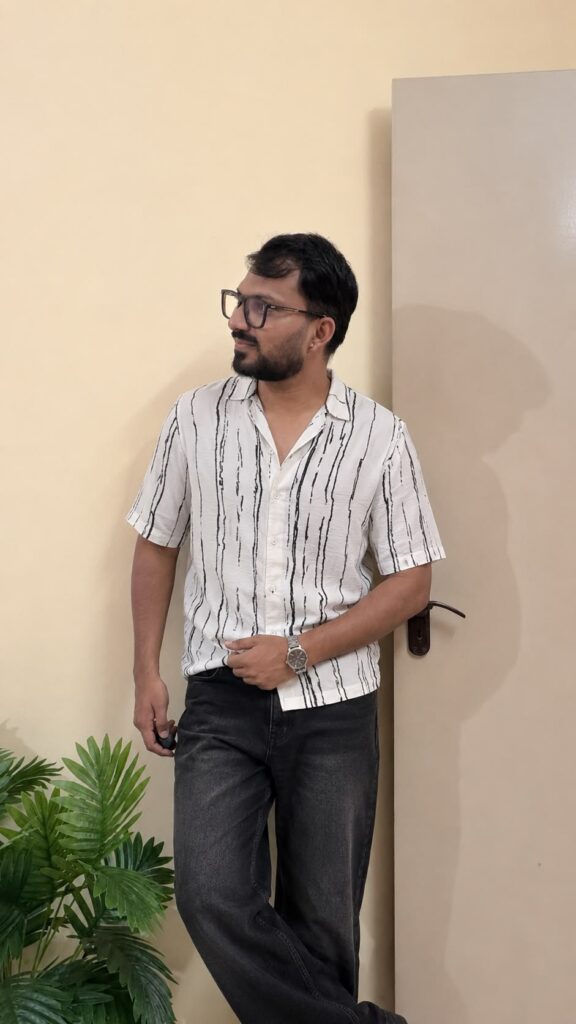
This one tucks the shirt into dark charcoal jeans, front-tucked on one side. It works for college, casual office days and weekend plans because monochrome reads deliberate even when the pieces are casual. Two colors, zero decisions.
Why a white and black striped shirt men keep in rotation
Monochrome outfits live or die on contrast, and thin black stripes on white give you contrast without bulk. The stripes here are narrow, which reads refined; wide barber stripes would read louder and younger. Narrow stripes are the grown-up version.
The white ground keeps the shirt bright and daytime. A black-ground shirt with white stripes would read evening; this one reads morning. That is why it works for college and day plans and why it would look wrong at a late dinner.
The drop-shoulder cut
Drop shoulders push the seam down the arm, which widens the silhouette and relaxes the whole shirt. It is a streetwear cut, and it changes the shirt’s character: the same stripes on a tailored shoulder would read office; on dropped shoulders they read casual.
The trade-off is structure. A drop-shoulder shirt will never look crisp, so do not ask it to. Embrace the slouch. Iron it, sure, but the shirt’s attitude is relaxed, and fighting that with stiff styling misses the point.
The half-tuck trick
The front tuck here is doing real work. It shortens the torso visually, defines the waist, and stops the straight hem from reading boxy. With drop shoulders and a relaxed body, an untucked hem would look shapeless; the tuck adds the shape back.
One side tucked is the move. A full tuck would formalize a shirt that refuses to be formal; no tuck would leave it hanging. The half tuck is the compromise, and it only works when the jeans sit at the waist, not below it.
Charcoal jeans as the anchor
Dark charcoal jeans under a white-ground shirt is a tonal move: light top, dark bottom, maximum separation. The jeans read almost black, which keeps the monochrome tight. Blue jeans would introduce a third color and break the spell.
Keep the jeans plain. Rips or heavy fading would add a texture the stripes do not need. A clean dark denim lets the shirt’s pattern be the only event in the outfit.
The sneaker question
Monochrome tops give you freedom below, but not total freedom. White sneakers are the natural partner: they echo the shirt’s white ground and keep the outfit light. Black sneakers would work too, but they darken an outfit that is already anchored by charcoal denim.
What does not work is color. A red or royal blue sneaker would introduce a third color into a two-color outfit, and the whole point of monochrome is that there is no third color. The shirt made a decision; the shoes should respect it.
Shoe shape matters as much as color. A slim low-top keeps the silhouette clean; a bulky runner would add visual weight the drop-shoulder shirt does not need. The outfit is relaxed up top, so the shoe should stay neat below.
Keeping stripes aligned
Drop-shoulder seams make ironing tricky; press along the stripe direction and let the shoulder sit naturally. Wash cold, inside out, and the black stays black instead of going grey.
Hang it by the shoulders, not the collar, or the camp collar will stretch. Getting dressed does not get easier. Stripes up top, dark denim below.
 MEN’S STYLE