The Styling Note
Why this look
earns its place.
Fit, balance, colour, and context—explained for real-world wear.
Red embroidered kurta outfit for women: the festive red edit
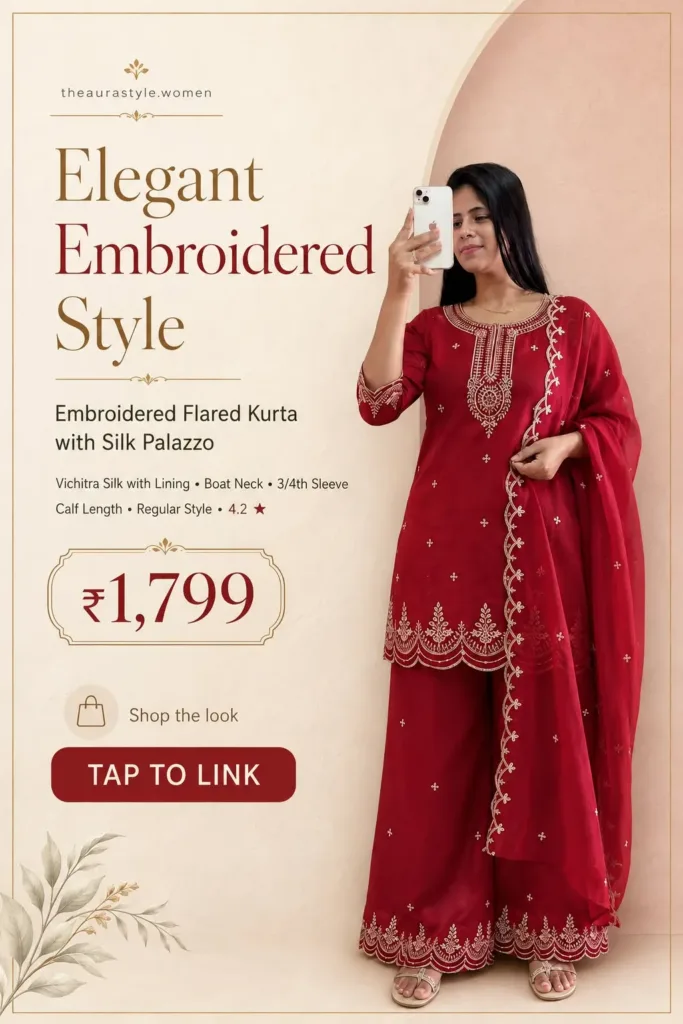
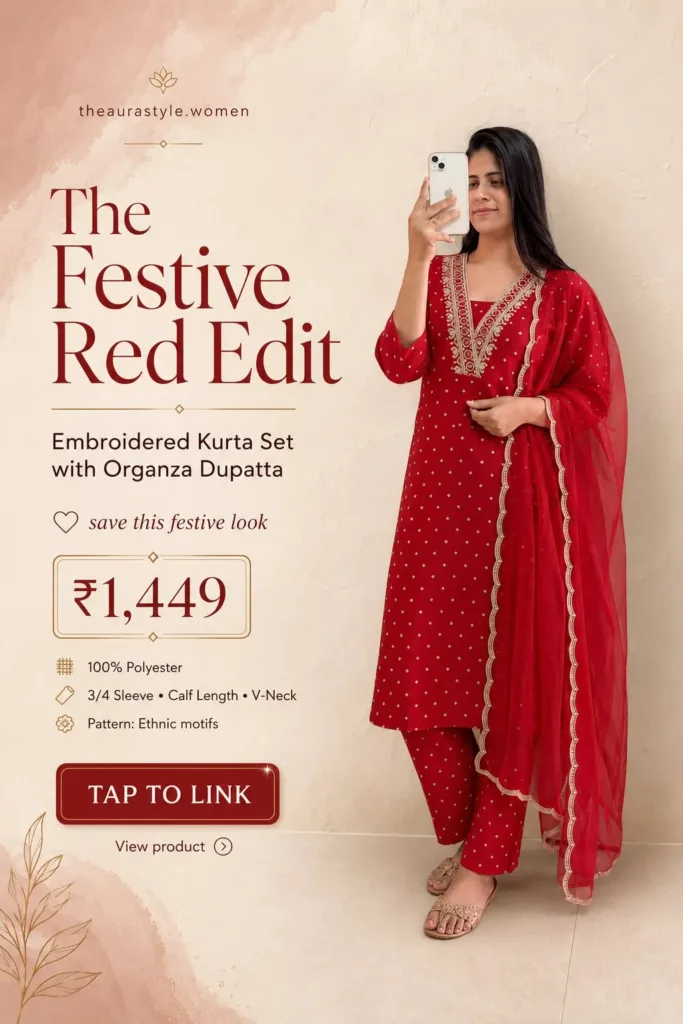
Some festive outfits try too hard. This red embroidered kurta outfit for women does the opposite — a straight red kurta, matching straight pants, and a sheer organza dupatta with a gold scalloped edge. The colour does the heavy lifting so the details only have to whisper.
What the Look Is
The kurta is straight-cut and calf length, with a V-neck framed in gold ethnic embroidery that runs down the front placket. Small butti dots scatter across the kurta and the pants, dense enough to read as texture rather than print. Sleeves stop at three-quarters, which keeps bangles or a watch visible if you want them there. The dupatta is organza, genuinely sheer, finished with a wavy gold border that catches light every time it moves.
Why the V-Neck Does More Work Than You Think
A V-neckline opens up the frame, and that matters here because the red is saturated and the embroidery sits right at the collarbone. The gold threadwork pulls the eye upward, so the look reads polished even if you skip heavy jewellery. If your hair is long, wear it loose over one shoulder and the neckline stays the focal point. Tie it back and the embroidery carries the whole upper half on its own.
Styling It: Keep Everything Else Quiet
The set photographed with flat strappy sandals works because red this strong does not need heels to announce itself. That is also the general rule for this outfit. One finished detail beats five stacked ones.
- Jewellery: small gold jhumkas or a pair of studs, plus one thin gold chain if the neckline embroidery is narrow on your set. Skip chokers; they fight the V.
- Footwear: flat strappy sandals for day functions, low block heels if the evening is dressier. Avoid anything neon or heavily embellished.
- Dupatta drape: one end pinned at the shoulder, the rest falling free behind. The scalloped edge is the point, so do not fold it into a thin band.
- Bag: a small gold or beige potli. Nothing structured and black.
When This Outfit Earns Its Place
This is a Diwali-outfit kind of red, but the cut keeps it useful beyond one festival. It fits Diwali poojas, dhanteras dinners, Karva Chauth gatherings, wedding sangeet mornings, and any family function where a sari feels like too much effort. The straight silhouette and 3/4 sleeves also make it easy to repeat without anyone noticing you are repeating it, change the dupatta drape or swap the earrings and it reads fresh.
The organza dupatta is the detail that keeps the set from tipping heavy. A solid or embroidered dupatta on top of an embroidered red kurta would double the weight visually; the sheer fabric adds movement and a gold edge without adding bulk. That’s why it can drape loose over the arms without the outfit feeling overdone. It reads as air rather than a third garment.
The polyester listing is worth reading straight. It means the red won’t bleed in the wash the way cotton reds do, and the straight cut holds its shape through a full day of sitting and standing. The trade-off is breathability in crowded rooms. It’s a festive-evening fabric, which is exactly the register the set is dressed for anyway.
Fit Notes Before You Buy
Calf length on the kurta is flattering, but only if the hem clears the knee cleanly; a kurta that hovers mid-knee shortens the leg line. Straight pants should sit close without pulling at the thigh. Because the fabric has no stretch (the set is listed as 100% polyester), check the shoulder seam lands exactly on your shoulder and the sleeve hits just below the elbow. Polyester in red also runs true to colour in photos, so what you see is close to what arrives.
Price Point and What It Means
At ₹1,449 for a three-piece set, this sits in the honest mid-range: real embroidery and a proper organza dupatta, in a set that survives a full festive season of wearing and washing if you wash the kurta inside out and hang the dupatta rather than machine-drying it.
Hand-wash the embroidered areas. Gold threadwork fades fastest in hot water and hard spinning, and organza creases permanently if wrung. Thirty extra minutes of care is what separates a set that lasts three Diwalis from one that looks tired by the second.
Buy the red when the function matters and you want to look like yourself, just a touch more deliberate.
 WOMEN’S STYLE