The Styling Note
Why this look
earns its place.
Fit, balance, colour, and context—explained for real-world wear.
The look
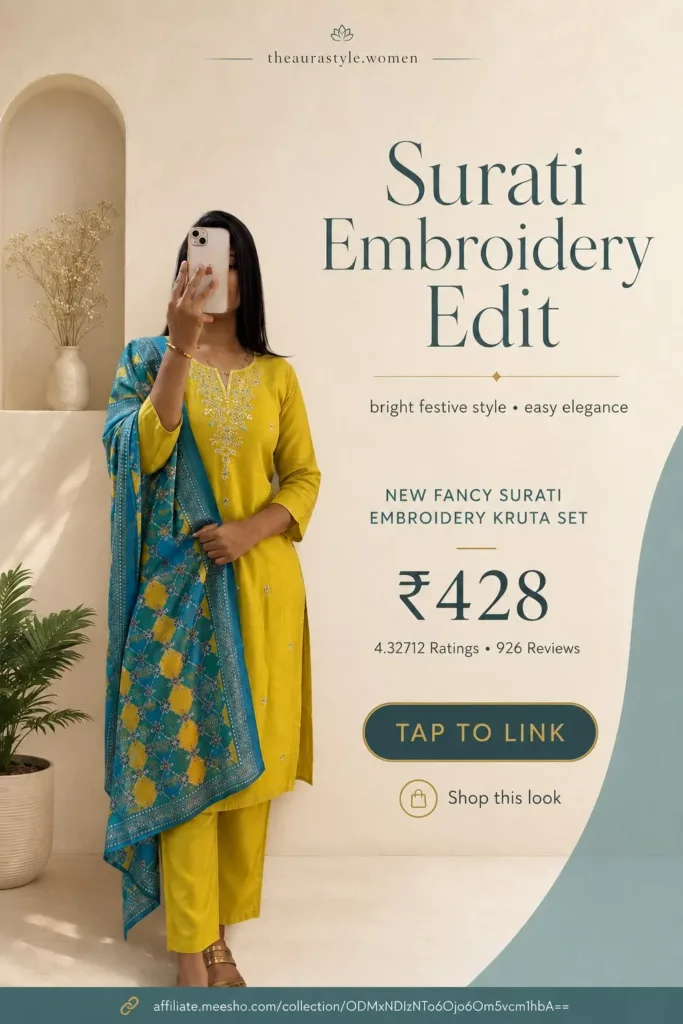
This yellow surati kurta outfit for women is built around a bright yellow straight kurta, with Surati embroidery worked across the yoke in dense, fine stitching that frames the neckline and gives the plain body its detail. The kurta runs to just below the knee, straight through the body, with three-quarter sleeves. It comes with matching yellow trousers and a contrasting printed dupatta in teal blue, patterned with yellow and white floral diamonds. The dupatta does the colour work; the kurta does the structure.
Why the yellow and teal pairing works
Yellow and teal sit far enough apart on the colour wheel to create real contrast without clashing. The dupatta’s print carries both colours, so this yellow kurta with blue dupatta pairing does not look accidental: the yellow motifs echo the kurta, and the teal ground gives the yellow somewhere to sit. A matching yellow dupatta would read flat; a plain one would waste the opportunity. The contrast print splits the difference.
Festive styling for a yellow surati kurta outfit for women
Drape the dupatta over one shoulder and let it fall, as shown, or pleat it narrow and pin it at the shoulder for a neater festive look. The embroidered yoke is the kurta’s one ornament, so keep jewellery light: small gold jhumkis or studs, one thin bangle. A heavy necklace would sit over the embroidery it is meant to frame.
Festive to everyday
For family functions and festive days, add gold-toned sandals, a small potli or clutch, and a bindi. For everyday ethnic wear, flat kolhapuris, a simple watch, and the dupatta draped loosely keep this kurta with printed dupatta easy to wear. The kurta itself does not change; the accessories decide how dressed it is.
Where this outfit fits
As a yellow kurta festive outfit it covers festive days, family functions, pujas, and everyday ethnic styling. Yellow is a daytime colour by nature, so this kurta suits morning and afternoon functions best. For evening events, deeper accessories, gold jewellery, and a darker lip shift this yellow surati kurta outfit for women into the night.
Fit notes worth knowing
A straight kurta should skim, not cling. Check that the side slits fall at the hip and the shoulders sit clean. The yoke embroidery needs to lie flat across the chest; if it puckers, the kurta is too tight and the stitching will pull. The trousers should be slim but not skin-tight, ending at the ankle so they do not bunch under the hem. Between sizes, fit the shoulders first and get the trousers altered.
Draping the printed dupatta
The teal dupatta’s print is loud enough to carry a whole side of the outfit, so how you drape it matters. Over one shoulder and falling loose, as shown, it reads relaxed and shows the full pattern. Pleated narrow and pinned at the shoulder, it reads formal and keeps the print controlled for a function. For a puja or a morning event, drape it over both shoulders like a stole; the print frames the yellow kurta instead of cutting across it.
Getting a second outfit out of the kurta
The yellow kurta and trousers separate cleanly. Pair the kurta with a plain white or cream dupatta for a quieter day look: the Surati yoke becomes the only detail and the whole set calms down. Pair the trousers with a white or printed short kurti when the yellow kurta is in the wash. A yellow embroidered kurta set that splits into two outfits is doing more than a set that only works together.
Before you buy
Zoom into the embroidery in the product photos. On a surati embroidery kurta the work should be fine and dense; sparse or uneven stitching is a reason to skip. Check the dupatta length too: one that barely reaches the waist limits how you can drape it. And confirm the trouser fabric matches the kurta in the listing, since sets sometimes mix weights.
 WOMEN’S STYLE